Hello, welcome to China Lift Sling Net Belt Factory
语言选择:  ∷

∷ ∷ 
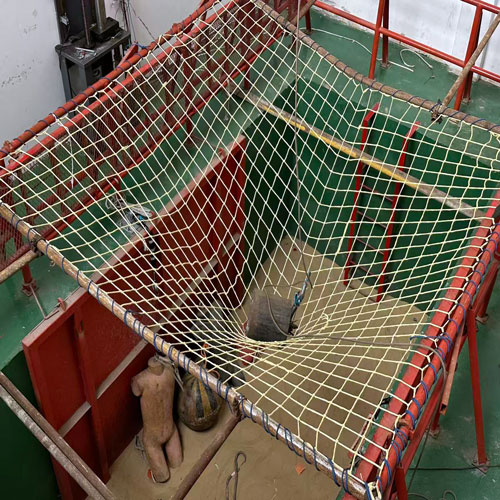


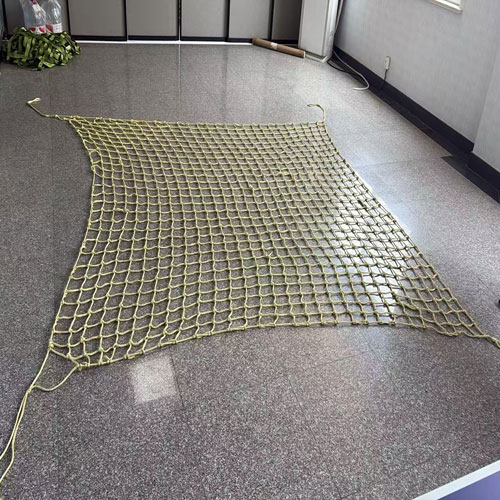
Lift Sling Net Belt Factory produce Aramid Anti-Drone Nets,Anti-drone netting,Drone protection nets,Anti-drone mesh,Ukraine covers frontline roads with anti-drone nets,Drone safety net,
Aramid anti-drone nets from Lift are knotted netting built from para-aramid (Kevlar-type) rope, used to physically intercept small unmanned aircraft. Lift aramid rope carries 2.6 t at 6 mm and 7 t at 10 mm per leg; because four legs meet at every knot, a 10 mm knotted net reaches roughly 28 t at a single node. Mesh 40–100 mm, panels to 10 × 30 m, reinforced border with eyelets. Knotted construction is the reason this net holds — a knotless braided aramid net loses strength exactly where it is hit.
Para-aramid has almost no elongation. That is an advantage in a sling and a liability in a net, because a net has hundreds of points where two rope directions cross.
In a knotless braided net, the warp and weft fibres bear directly on each other at every intersection. Once the net is tensioned and then struck, those crossings act as a knife edge: fibre cuts fibre, with no stretch to relieve the load. The damage is invisible from outside — the net looks intact while the strand at each crossing has been notched. A knotless aramid net therefore tests well as rope and fails early as net, precisely at the impact zone.
A knot removes that failure mode. Rope bears on rope in a helical grip instead of fibre on fibre at 90°, and the knot body becomes the bearing surface. Four legs meet at each knot, so the node carries up to four times the single-rope break:
10 mm Lift aramid rope = 7 t per leg → ≈ 28 t at the knot
6 mm Lift aramid rope = 2.6 t per leg → ≈ 10.4 t at the knot
Knotted netting costs more — more rope per square metre, and knotting is slow work. But for a net whose only job is to absorb an impact, knotted is the cheaper option per tonne of intercepted energy, and it is the only construction we recommend for a high-strength anti-drone net.
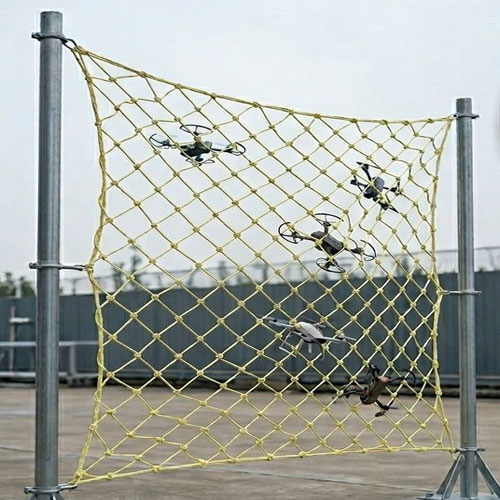
Once the construction is right, aperture is the next decisive figure. If it is larger than the airframe's widest span the drone passes; if it is far smaller than needed you pay for material and wind load you do not use.
| Model | Mesh | Rope Ø | Rope MBL | Knot node (≈4×) | Standard panel | Intended target |
|---|---|---|---|---|---|---|
| ADN-40 | 40 × 40 mm | 6 mm | 2.6 t | ≈ 10.4 t | 5 × 10 m | 5-inch FPV, small loitering munitions |
| ADN-60 | 60 × 60 mm | 6 mm | 2.6 t | ≈ 10.4 t | 10 × 10 m | 5–7 inch FPV, Mavic / Mini class |
| ADN-80 | 80 × 80 mm | 10 mm | 7.0 t | ≈ 28 t | 10 × 20 m | Matrice class, heavy-lift multirotor |
| ADN-100 | 100 × 100 mm | 10 mm | 7.0 t | ≈ 28 t | 10 × 30 m | Fixed-wing recon, wide road / perimeter cover |
Rope MBL is the single-leg minimum breaking load of Lift aramid rope at that diameter. Knot node strength is the four-leg value at the knot, not a doubled rope test. Other diameters from 4 to 12 mm and other apertures are made to order; mesh and rope diameter can be combined freely.
Steel wire mesh is the default alternative, and at rope level the two are closer than most buyers expect. The gap appears at the joints — which is where a net actually carries load.
| Rope Ø | Galvanised steel wire rope MBL | Lift aramid rope MBL |
|---|---|---|
| 3 mm | 380 kg | — |
| 4 mm | 510 kg | — |
| 6 mm | — | 2.6 t |
| 10 mm | 5.6 t | 7.0 t |
A 10 mm steel wire rope breaks at 5.6 t, but a steel wire net is not joined by the rope — it is joined by aluminium ferrules pressed on site, rated 4–5 t. The net is therefore no stronger than 4–5 t at every connection, and the rope's extra tonne is never realised. A knotted aramid anti-drone net has no ferrules at all: the knot is the joint, and at 10 mm it carries roughly 28 t. The comparison is won at the joints, not on the rope data sheet.
| Item | Steel wire mesh | Knotted aramid net |
|---|---|---|
| Rope MBL at 10 mm | 5.6 t | 7.0 t |
| Strength at each joint | 4–5 t (pressed aluminium ferrule) | ≈ 28 t (knot, four legs) |
| Weight per metre at 10 mm | ≈ 0.62 kg | ≈ 0.07 kg |
| Net weight, same panel | Baseline | About one-ninth |
| Installation | Crane or plant, rigging gloves | Four people, hand tools |
| Corrosion | Rusts at cuts and ferrules | None |
| Radar signature | High — visible as a structure | Very low, non-metallic |
| Behaviour on impact | Ferrule slips, broken wire whips | Mesh deforms, knot holds, no stored energy |
| Field repair | Cut out section, re-ferrule with press | Re-tie the knot by hand |
Net weight is quoted per panel on order. The one-ninth comparison is for the same nominal diameter; a knotted aramid net also uses slightly more rope per square metre than a knotless one, which is part of why it costs more and holds more.
| Property | Specification |
|---|---|
| Fibre | 100% para-aramid (Kevlar-type) multifilament, Lift rope |
| Net construction | Knotted, square diamond mesh — not knotless braided |
| Mesh aperture | 40 / 60 / 80 / 100 mm standard, others to order |
| Rope diameter | 6 mm (2.6 t) and 10 mm (7.0 t) standard; 4–12 mm on request |
| Knot node strength | ≈ 4 × single-rope MBL (10.4 t at 6 mm, 28 t at 10 mm) |
| Panel size | 5 × 10, 10 × 10, 10 × 20, 10 × 30 m; joined panels for longer runs |
| Border | Reinforced edge rope, doubled at the perimeter |
| Fittings | Eyelets every 500 mm / 1 m, no pressed ferrules in the mesh |
| Colour | Sand, olive drab, khaki, black — low visual signature |
| Heat behaviour | Non-melting, chars and self-extinguishes; continuous service above 200 °C |
| UV protection | UV-stabilised finish applied to the rope (see section 7) |
A knotted aramid anti-drone net is specified where the threat is a small airframe and the consequence of a single hit is out of proportion to the cost of the net. Six applications account for most orders.
Frontline road and position cover. Nets suspended over supply routes and trench sections against FPV and loitering munition strikes — the application that made this specification standard equipment in Ukraine. At 10 mm the knot node sits near 28 t, which is sized for the impact of a one-way attack drone at terminal speed rather than for an anti-tank warhead.
Critical infrastructure. Substations, refineries, water treatment and telecom towers, where one small drone causes disproportionate outage.
Airfields and drone test ranges. Containment around test corridors and approach paths.
Fuel farms and ammunition storage. Overhead cover between revetments, where metallic mesh is both a radar marker and a spark risk.
Detention and secure facilities. Perimeter cover against contraband delivery flights.
Public events and VIP sites. Temporary frames erected for the event and struck afterwards.
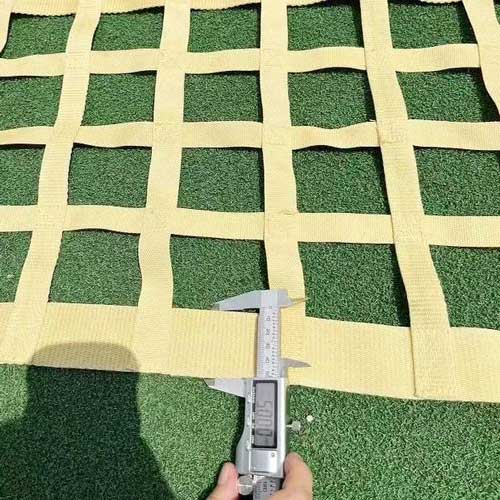
The same workshop produces the full safety rope net range, including large-span work such as the helideck landing net and fall protection knotted rope net. Where the net is purely for physical safety and stays outdoors for years, a UV-stable synthetic is the better choice — see the knotless polyethylene safety rope net. Rope supply is covered under nylon rope, and load-bearing nets under cargo lifting nets.
Post spacing
5–10 m between posts, 3–6 m clear height. Closer spacing reduces sag; wider spacing needs a heavier border rope, not a heavier mesh.
Load path
Tension the border rope only. Pulling the mesh directly distorts apertures and opens the gaps a drone will find.
Panel joins
Overlap adjacent panels 100–150 mm and lace through every second eyelet with aramid cord — never cable ties alone.
Clearance
Keep 0.3–0.5 m between the net and the structure behind it, so a captured drone is not bounced back out of the mesh.
Knot inspection
Aramid has almost no elongation, so a slack knot does not tighten itself under load. Check knot seating at installation and after the first tensioning cycle; a knot that has worked loose should be re-set by hand.
UV exposure
Aramid degrades under ultraviolet light. Specify the UV-stabilised finish for permanent outdoor use, inspect at 12 months, and expect 18–24 months of continuous high-UV service before replacement. Nets stored under cover last considerably longer.
After a strike
Inspect the strike zone for cut strands and widened apertures, and replace the affected panel or re-tie the damaged knots. A net that has caught one drone is not automatically fit for the next.
Knotted aramid anti-drone nets are built to order: mesh, rope diameter, panel size, colour and border fittings are specified per project. Standard panels typically leave the workshop in 15–25 days, with longer runs scheduled against quantity; minimum order depends on panel size and rope diameter, so send the specification and we will quote against it. Export packing is rolled and strapped in woven bags with labels to your format. Material certificates ship with every order; third-party test reports on request.
Factory profile and workshop capability: company profile.
A: 40–60 mm. A 5-inch FPV is roughly 250 mm motor-to-motor, so 60 mm sits comfortably below half the propeller span and the airframe cannot pass through. Use 40 mm where the same net must also stop smaller loitering munitions.
A: Because aramid barely elongates. In a knotless net the two rope directions bear directly on each other at every crossing, and under tension those crossings cut fibre against fibre — the net looks intact but the strand at each crossing is notched. A knot replaces that contact with a rope-on-rope helical grip and gives four legs at each node, so the joint carries up to four times the single-rope break. Knotted costs more and is the construction we recommend for any net that has to take an impact.
A: It is the four-leg value at a node, not a test of a doubled rope. Lift 10 mm aramid rope breaks at 7 t per leg; four legs meet at each knot, giving roughly 28 t at the node. At 6 mm the rope breaks at 2.6 t per leg, so the node is about 10.4 t.
A: Through eyelets on the reinforced border, using lacing cord, shackles or stainless thimbles. The border carries the load — tension the edge rope, not the mesh. Eyelet spacing is made to match your frame, typically every 500 mm or 1 m. No pressed ferrules are used inside the mesh, so there is no 4–5 t weak point in the panel.
A: With the UV-stabilised finish, yes, but aramid does degrade under sustained ultraviolet exposure. Inspect at 12 months and plan replacement at 18–24 months in high-UV climates; nets taken down between deployments last considerably longer.
A: Both depend on panel size and rope diameter. Standard panels typically ship in 15–25 days. Send mesh, rope diameter, panel size and quantity and we will confirm MOQ, price and delivery in one reply.
 Sweep WeChat yards pay attention to us

24-hour hotline0523-86933296

The mobile phone13961011588
Copyright © China Lift Sling Net Belt Factory & Copyright Address:JiangPing East road, TianHe Town, TaiZhou City,JiangSu Procince,China 苏ICP备10051201号-3